
Director of Marketing
[In-house]
XPT is a human performance coaching brand founded by Laird Hamilton and Gabby Reece, owned by FitLab. They’d spent years developing a holistic training method and hosting events for their inner circle. The method worked. It wasn’t yet a business.
My goal. Three tasks: turn a collection of ideas into a clearly positioned business, grow an engaged audience, and build experiential products that could scale.
High-level result. A brand positioning platform. 70k to 100k followers. And Expeditions — a first-of-its-kind series that sold out three high-ticket experiences.
01
02
Brand positioning platform
Great ingredients, no unifying idea.
The problem. XPT had deep credibility and a methodology shaped by people performing at the highest levels. But nobody could say what it actually was. A training method, an events company, a coaching practice — it was being run as all three. And to grow, it had to reach high performers who’d never surfed a wave that could kill them, without diluting what made the method credible.
The insight. The person XPT needed to reach already thinks of themselves as a high performer — just not in the arenas the methodology came from. Their version of elite is being the best parent in the room, or still having the energy for their life at fifty. They want everything the big-wave surfer and the special forces leader have. They just want to spend it somewhere else.
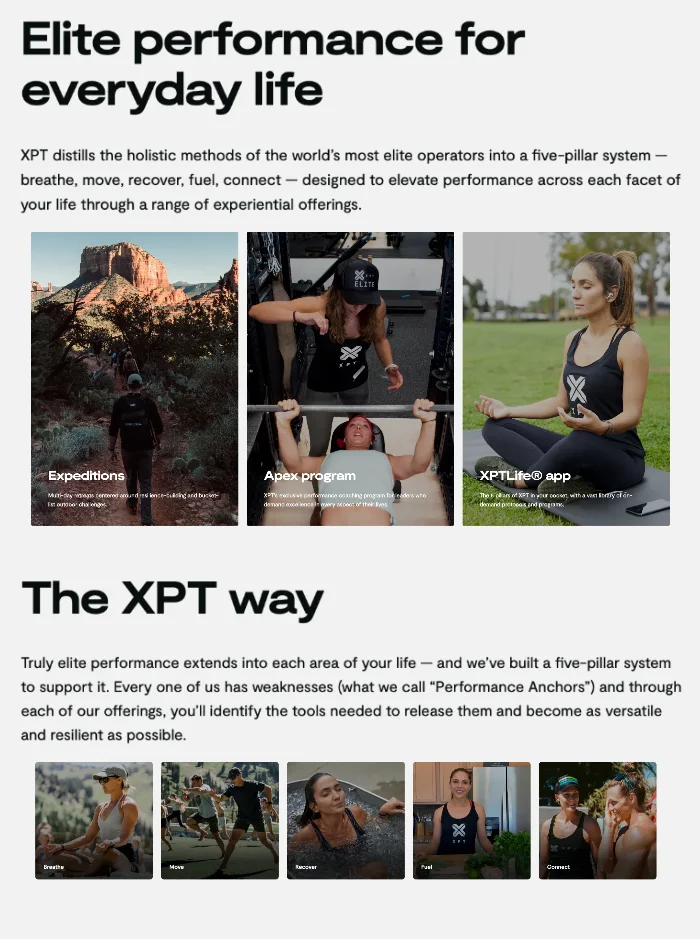
The work. First, a category: XPT is coaching. That one decision let everything belong — every offer became a way of being coached by people who’d operated at the highest level. Then the positioning. The principles turned out to be portable; breathing through pressure doesn’t require a 60-foot wave. So it could hold two opposites at once: not performance tools for the elite, but performance tools from the elite.
The result. Elite Performance for Everyday Life. Experiences, Expeditions and Apex stopped looking like three unrelated products and became three ways into the same methodology.
03
Expeditions
Where Limits Go To Die.
The problem. XPT’s existing retreats were extraordinary for the people who attended — the full training method used by some of the highest performers on earth, taught by the people who built it. But it was almost impossible to explain from outside. Watching it, you saw people doing a lot of impressive fitness things. That made it hard to sell, and hard to bring in brand partners and ambassadors. We needed a way into the XPT world that was just as good and far easier to understand.
The insight. Every event in fitness falls into one of two camps. You sit in a room and listen to experts, or you go outside and do hard things. The first gives you tools with nowhere to use them. The second gives you an experience with nothing to take home. Nobody was doing both: teaching something transferable, then making you prove it under real pressure.
The work. Expeditions — a once-in-a-lifetime challenge in some of the most demanding environments on earth, led by human-performance and challenge-domain experts. You learn resilience techniques and apply them in real time, on terrain that doesn’t forgive. Then I concepted and launched the 360 marketing that sold it.
The result. Three expeditions sold out, filled with high-profile ambassadors, speakers and brand partners who wanted to be part of the story.
04


XPT Studio
Every brand in the category was saying the same word.
The problem. XPT helped bring ice baths and saunas to people who weren’t athletes, in the mid-2010s. But the business was a three-day retreat for thirty people. Moving into brick-and-mortar contrast therapy studios meant reaching a far bigger audience — in a market saturating fast.
The insight. I visited every ice bath and sauna studio within driving distance: Pause, RVIVL, IcePass, Remedy Place, Open. They all claimed to be the original social wellness space, and they all positioned around the same vocabulary. Relax. Revive. Rejuvenate. Beautiful earthy rooms, calm music — and all of it meeting people reactively. Hungover, tired, stressed? Book a session.
The work. XPT has never treated cold and heat as recovery tools. They sharpen you before a meeting, build resilience for what’s coming. That thinking runs through the whole studio experience, from audio-guided breathwork to coach-led classes built around specific goals. A category you visit when something’s wrong becomes one you use every day. That’s an active practice, not a reset — so we named it: Performance Wellness.
The result. The world’s first Performance Wellness studio. 200+ founding memberships sold in presale, more than double the projection based on industry benchmarks — proof the positioning landed before a single door opened. The studio didn’t ultimately launch, but the platform had already done its job.
05


Social media
An account living off its founders’ fame.
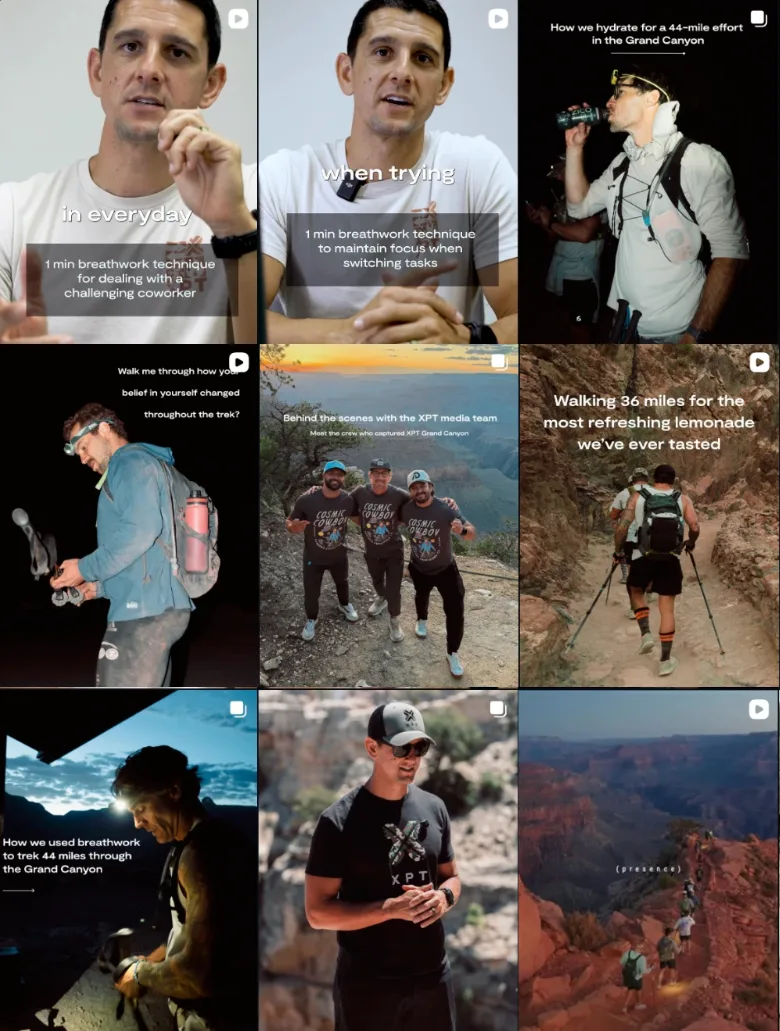
The problem. XPT’s social was pictures of Laird, Gabby and events. That works until it doesn’t — the audience belonged to two people, not to the brand, and there was no reason for anyone outside their orbit to follow. The method was the most valuable thing XPT had and almost none of it was on the feed.
The work. A content system built on four pillars. Education — the science behind XPT’s five pillars, breathe, move, recover, fuel and connect, made digestible and immediately usable. Philosophy — how high performers actually approach life, drawn from Laird, Gabby and the coaches. Community — content from members at events. Product — upcoming events and the app.
To reach past the existing audience, we leaned on borrowed reach: collaborations with advisors, Instagram Lives with other leaders in the space, and high-volume live posting from events so people could feel what it was like to be there.
The result. 70k to over 100k followers, and an audience that came for the method rather than the founders.
06